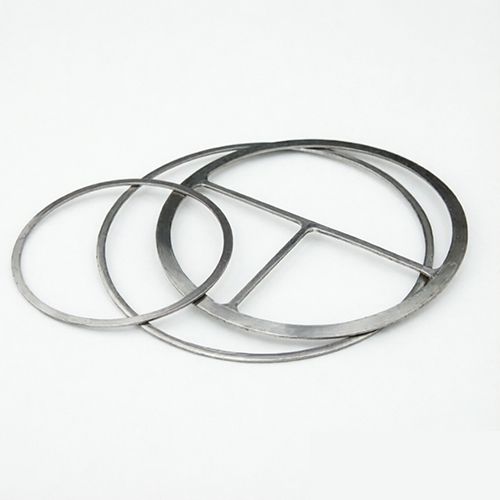

What is the temperature range for kammprofile gaskets? If you specify or buy sealing products for flanged connections, this question often becomes the first technical gate in procurement. Kammprofile gaskets combine a grooved metal core with a compressible facing layer, making them a preferred choice for heat exchangers, piping flanges, and pressure vessels. In general, graphite-faced kammprofile gaskets operate continuously from -200°C to 550°C in air, and can tolerate steam or non-oxidizing environments up to about 750°C. PTFE-faced versions have a narrower range, typically from -200°C to 260°C. But these figures are not universal. The actual temperature limit changes with the metal core material, flange material, gasket thickness, surface finish, bolting load, thermal cycling, and the chemical composition of the process media. A wrong assumption can lead to blowouts, flange corrosion, or unnecessary procurement costs. Ningbo Kaxite Sealing Materials Co., Ltd. helps buyers move beyond catalog numbers and match the correct kammprofile gasket to real operating temperatures, reducing both leak risk and total cost. The following guide breaks down the temperature range question into practical selection steps.
Imagine a purchasing engineer at a chemical plant receives a requisition for “kammprofile gasket, 6 inch, 300 LB.” The data sheet only lists a design temperature of 400°C. Without further checking, the buyer selects a standard graphite-filled kammprofile gasket with a 316L core. Six months later, a thermal cycle during shutdown causes a small leak, and maintenance teams spend two days isolating the line. The issue is not that the gasket was poor quality; the actual problem was temperature cycling combined with an aggressive trace acid, which degraded the graphite facing faster than expected. This pain point appears across refineries, power stations, and offshore platforms. The solution is to treat temperature range as an operating window, not a fixed rating. You must confirm the continuous maximum temperature, cyclic peak temperature, minimum temperature, and the oxidizing or reducing nature of the atmosphere. Ningbo Kaxite Sealing Materials Co., Ltd. supplies kammprofile gaskets in multiple core and facing combinations precisely because one number cannot cover all sealing conditions.
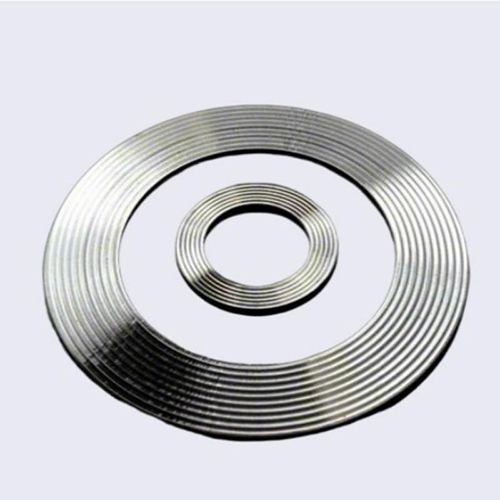
Below image shows a typical kammprofile metal gasket profile with a serrated metal core and soft facing layer.
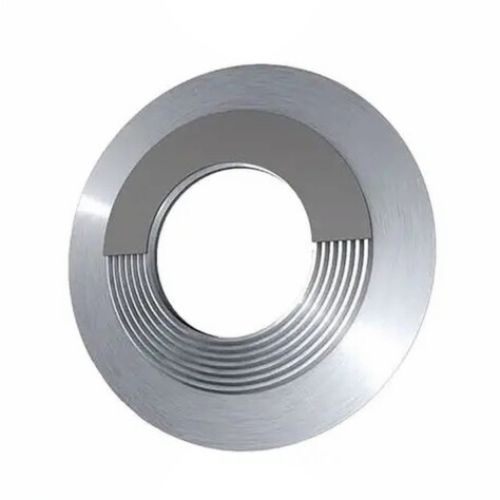
The metal core is the backbone of a kammprofile gasket. It supplies mechanical strength and resists blowout under high pressure and temperature. However, not all metal cores behave the same way when the flange heats up. A buyer who ignores core selection may end up with a gasket that relaxes, deforms, or loses seating stress long before the facing material fails. The following table gives practical temperature ceilings for common core materials.
| Metal core material | Continuous max in air | Max in steam/non-oxidizing | Common application |
|---|---|---|---|
| Carbon steel | 450°C | 500°C | Low-pressure steam, general piping |
| 304 / 304L stainless steel | 550°C | 750°C | Refinery, chemical lines |
| 316 / 316L stainless steel | 550°C | 750°C | Corrosive media, offshore |
| 321 stainless steel | 600°C | 800°C | High-temperature flue gas |
| Alloy 400 / Monel | 450°C | 550°C | Alkaline, seawater |
| Alloy 625 / Inconel | 650°C | 900°C | Oxidizing high-temperature |
The table is a starting point. If your process includes frequent thermal shocks, high oxygen levels, or aggressive chemicals, the safe continuous temperature may be lower than the listed value. Ningbo Kaxite Sealing Materials Co., Ltd. recommends verifying the core material against actual site data instead of relying only on a generic rating.
The facing layer creates the seal by flowing into flange imperfections under bolt load. Graphite and PTFE are the two most common facing materials, but their temperature limits are very different. Choosing the wrong one is a frequent root cause of leakage. The table below compares the two materials under typical conditions.
| Facing material | Min temperature | Max continuous in air | Max in non-oxidizing atmosphere | Main limitation |
|---|---|---|---|---|
| Flexible graphite | -200°C | 550°C | 750°C | Oxidation above 550°C in air |
| PTFE | -200°C | 260°C | 260°C | Decomposition above 260°C |
Answer: In most industrial flange applications, graphite-faced kammprofile gaskets are rated from -200°C to 550°C for continuous service in oxidizing conditions. In steam, hydrogen, or other non-oxidizing atmospheres, the graphite facing can handle short-term peaks up to 750°C, provided the metal core also supports that temperature. Procurement teams should still check the purity of the graphite and the binder system because low-quality graphite can start losing weight above 450°C.
Pain point: a hydrogen reformer outlet line operates at 620°C in a hydrogen-rich environment. A buyer uses a PTFE-faced kammprofile gasket because the datasheet only lists “max 200°C” but no atmosphere detail. PTFE degrades quickly above 260°C, causing a blowout and 14 hours of downtime. The plant then faces both production loss and a safety audit. The solution is to restore the joint with a graphite-faced kammprofile gasket and an Alloy 625 core, then verify bolting stress to maintain seating under thermal expansion. Ningbo Kaxite Sealing Materials Co., Ltd. often supplies this combination for reformer and hydrogen service, helping operators avoid repeated failures.
| Parameter | Wrong selection | Correct selection | Reason |
|---|---|---|---|
| Facing | PTFE | Graphite | Graphite survives 620°C in H2 |
| Core | 316L | Alloy 625 | Higher strength at high temperature |
| Flange class | 300 LB | 600 LB | Greater seating stress margin |
| Result | Blowout | Sealed joint | Correct thermal matching |
To avoid over-specification or under-specification, ask these questions before selecting a kammprofile gasket:
With these answers, a seal manufacturer can narrow the combination quickly. For example, a standard ASME B16.5 carbon steel flange with a graphite-faced 316L core often works up to 400°C, but above 400°C you may need a stainless steel or alloy core to avoid flange creep mismatches. Ningbo Kaxite Sealing Materials Co., Ltd. provides a technical questionnaire to help buyers collect the right data from site engineers, reducing back-and-forth delays.
Use the following table as a practical starting point, not as a substitute for engineering judgment. The actual temperature range may be reduced by chemical attack, thermal cycling, and low seating stress.
| Facing + core combination | Min temp | Max continuous in air | Max in steam/non-oxidizing | Typical service |
|---|---|---|---|---|
| Graphite + carbon steel | -200°C | 450°C | 500°C | General steam, water |
| Graphite + 304/316 stainless steel | -200°C | 550°C | 750°C | Refinery, chemical lines |
| Graphite + 321 stainless steel | -200°C | 600°C | 800°C | High-temperature gas |
| Graphite + Alloy 625 | -200°C | 650°C | 900°C | H2, reformer, oxidizing service |
| PTFE + 316L stainless steel | -200°C | 260°C | 260°C | Acids, high-purity chemicals |
Answer: PTFE-faced kammprofile gaskets are generally rated from -200°C to 260°C in continuous service. They are chosen when the process media is aggressive to graphite, such as strong oxidizing acids, high-purity food-grade fluids, or pharmaceutical applications. Above 260°C, PTFE decomposes and loses mechanical strength, so even a 300°C steam line should not use a virgin PTFE facing.
Answer: A graphite-faced kammprofile gasket with a carbon steel core usually works from -200°C to 450°C in air. In non-oxidizing steam it may reach 500°C for short periods. Carbon steel cores are cost-effective but should not be used above 450°C in oxidizing conditions because the metal itself scales and loses strength. For higher temperatures, a stainless steel or alloy core is the safer choice.
Procurement teams often struggle with vague datasheets, limited product options, and slow supplier feedback. Ningbo Kaxite Sealing Materials Co., Ltd. solves this by offering a focused range of kammprofile gaskets with different core and facing combinations, supported by temperature-pressure charts and material certificates. Instead of forcing one standard product into every application, the company helps you select a gasket that actually matches your process window. This reduces leak risk, extends maintenance intervals, and lowers total sealing cost.
Have you verified whether your current kammprofile gasket temperature range covers start-up peaks? If not, send flange data, operating temperatures, and process media details to a technical supplier before placing the next order. A small data check now can prevent unplanned downtime later.
For procurement and engineering teams who want reliable sealing without guesswork, Ningbo Kaxite Sealing Materials Co., Ltd. offers kammprofile gaskets, spiral wound gaskets, and related sealing products. Visit https://www.metal-gaskets.com to explore materials and submit an inquiry, or contact [email protected] for technical support and a quotation.
Bickford, J. H., & Payne, J. R. (2019). Leak tightness of kammprofile gaskets under thermal transient conditions. Journal of Pressure Vessel Technology, 141(3), 031204.
Zhou, Y., & Chen, M. (2020). Oxidation behavior of flexible graphite in flanged joints at elevated temperatures. Sealing Technology, 2020(5), 7–12.
Schmidt, T., & Ling, P. (2018). Influence of serrated metal core geometry on the seating stress of kammprofile gaskets. International Journal of Pressure Vessels and Piping, 166, 55–63.
Nakamura, K., & Fujita, H. (2017). High-temperature performance of PTFE-filled kammprofile gaskets in chemical plant service. Journal of Chemical Engineering of Japan, 50(8), 612–619.
Brown, A. L., & Mercer, R. F. (2016). Comparative study of spiral wound and kammprofile gaskets in flanged joints under thermal cycling. Journal of Process Mechanical Engineering, 230(4), 245–253.
Patel, V., & Okafor, C. (2021). Effect of metal core material on the relaxation behavior of grooved metal gaskets. Materials Science and Engineering: A, 805, 140788.
Li, H., & Wang, D. (2019). Graphite degradation mechanisms in high-temperature hydrogen service. Corrosion Science, 158, 108096.
Johnson, E. R., & Saeed, M. (2020). Sealing performance of kammprofile gaskets under combined pressure and temperature loading. Engineering Failure Analysis, 112, 104512.
Thomas, G., & Rao, S. (2015). Finite element analysis of contact stress distribution in serrated metal gaskets. Procedia Engineering, 130, 934–942.
Kim, J., & Park, S. (2022). Low-temperature leak tightness of graphite-faced kammprofile gaskets in LNG flanges. Cryogenics, 124, 103467.
-